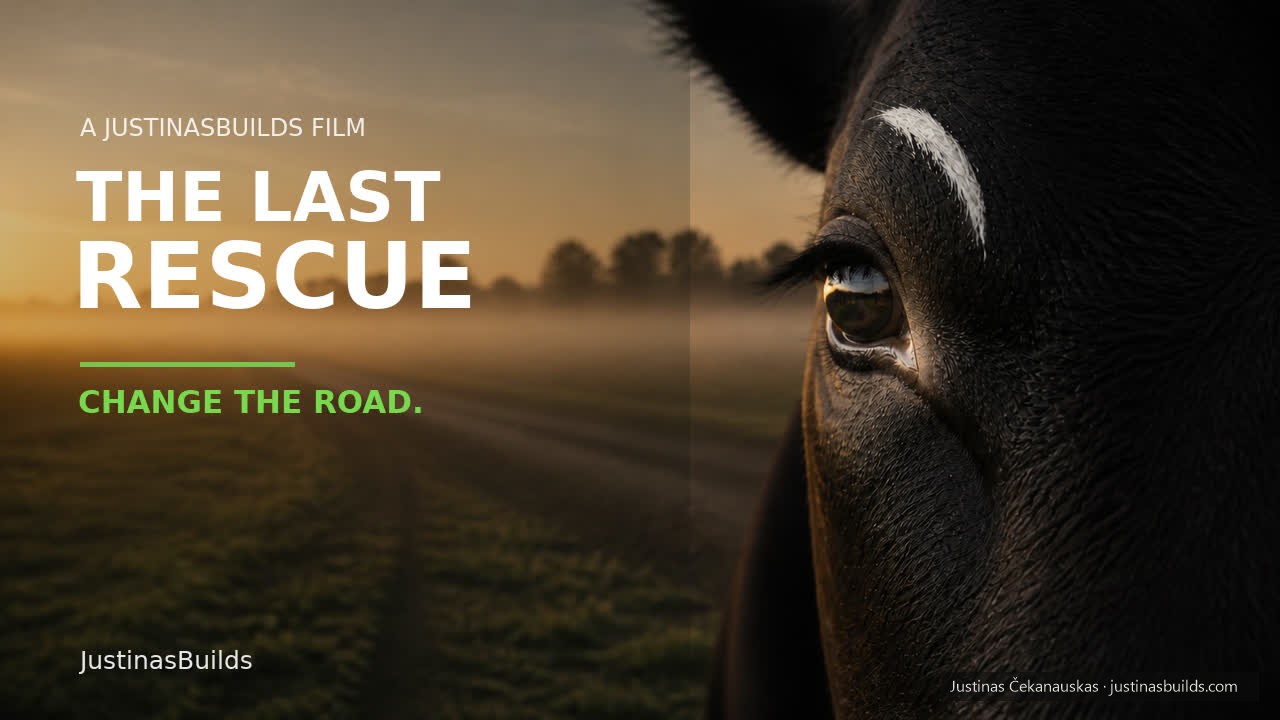
I spend most of my days reading official records, budgets, procurement tables, and policy drafts. So it is fair to ask why I spent time making a 94-second fictional short film.
The short answer is that the film shows the circle I am actually trying to understand every day.
When you read public records one document at a time, it is easy to see isolated decisions and lose sight of what they add up to. A short film lets you see the whole loop in one breath: why a single rescue matters deeply, why rescue alone never ends the system, and what changes when you redirect the road itself.
1. One individual, and the next truck
The film opens at dawn on the eye of a single cow inside a livestock trailer, and then on the moment she steps out onto wet grass.
That focus on one individual is the core of the entire scene. The system as it operates today almost always shows animals grouped together in large numbers.
When living beings are turned into things and crowded into a mass, something shifts in how people look at them. Their individuality disappears. What they sense, what they feel, what they look at even when they have no idea what is about to happen to them next, all of that fades out of view. Once someone is treated as part of a pile of things, people stop paying attention.
Starting with one cow was my way of insisting on the simplest fact first: this animal exists, is alive, and is not a thing.
In the very same scene, the trailer doors close, the truck pulls away, and muddy tire tracks stay pressed into the grass. That second beat matters just as much.
Rescuing one animal changes the entire world for that one life. It is real and it matters.
Yet rescuing one animal today, or a few tomorrow, does not stop the machine behind them. Another truck comes. The way the system is currently built, rescue alone can slow things down for a moment, but it can never bring the road to an end.
2. Following the road backward
From the gate, the camera turns around and follows the road backward through a warehouse, a feed mill, and grain silos.
I did not make this film to describe once again what happens to the cow at the end of the line. Most people already know enough to look away. What people have largely forgotten is how the rest of the system actually works before anything ever reaches a store.
We grow crops on vast stretches of land, route them through animals in captivity, and then eat the animals. Not every feed crop is identical to the grain people eat directly, because many feed varieties are bred specifically for livestock.
Still, the basic reality is simple: the land and fields growing feed for animals can grow food for people directly. Using livestock as an intermediate step to feed humans works in the worst proportion possible, because we put far more in than we ever get back. Remove that middle step, and we can produce far more food using far less land.
A product does not appear on a supermarket shelf by magic. A long chain of decisions, logistics, and handoffs happens in between.
Honestly, I think stores themselves should have to show how each product actually got to that shelf, because once you see the hidden detour built into the old default, it stops looking inevitable.
3. The farms were not the problem. The destination was.
Midway through the film, a worker pulls a diverter lever and the grain flows toward fermentation tanks, trays, and crates instead of animal feed.
Farmers are not the real problem. Most farmers are doing what they have done for a very long time, what they know best, and what was passed down across generations. The destination of the crop is the problem.
I also want to be honest about something a 94-second film can easily gloss over: none of this is simple in real life. There are real economic barriers, real debts, and real transitions to figure out.
You cannot expect a farmer to change everything overnight without real support and public transition subsidies behind them. Farmers support their families just like the rest of us do, and the last thing anyone wants is to hurt their family or put their livelihood at risk. If we want a different future, we have to build real backing so farmers and food workers actually have a viable new destination for what they grow.
There is also a reason the film names ordinary things like fermentation, trays, crates, and new buyers instead of turning the scene into an exclusive slogan. Calling the work by its real names opens the door to far more people.
Not because the goal stops being vegan, but because veganism is much more than a diet. Real food infrastructure gives farmers new buyers and gives ordinary people practical choices without shutting anyone out.
4. The easier road
Next, the film moves to a local food hub, cargo bikes, an electric van, and a warm dining hall where people eat together.
When the narration says the alternative became the easier road, I mean removing the unnecessary middle layers that drain value from both the grower and the eater.
In a local hub where a farmer's harvest comes straight from the farm, the grower has far more say over price, selection, and quality than when selling everything to a giant retail chain at the lowest squeezed price. It also cuts waste, because even imperfect produce that big chains reject can still be sold and eaten.
I still remember a philosophy teacher I once had who joked that humans spend their whole lives repeating three silly, unavoidable things: sleeping, drinking water, and eating.
He was right. In the end, every single one of us has to eat. So why not build a better system that lowers costs, widens access, and stops acting as if basic food has to be scarce when we already dedicate vast amounts of grain and farmland to feeding livestock?
From the farm, to the local hub, to the kitchen, to families and communities sharing a table, food does more than fill stomachs. It builds real bonds.
5. The open gate
The final scene mirrors the opening almost frame for frame, with only two things changed: the gate is open, and the truck is gone.
Someone watching that stillness could ask: what happened? Did we stop caring? Did we stop rescuing animals?
No. What happened is that we no longer need to rescue that cow because she is already free.
When you change how the system works at its root, you no longer have to keep building more shelters and pulling in more exhausted people just to save a fraction of an endless stream. You can put that same human energy into making the alternative so solid that the rescue is no longer needed.
An open gate and an empty road can only mean one thing: the alternative has started, systems can change, and the future is not forced on us.
We can change it if we really want to.
Why this sits next to my investigations
That is also why this fictional film belongs right next to my day-to-day primary-document work on justinasbuilds.com.
Every time I dig into official records, public budgets, or policy texts, I see the same pattern: one decision after another makes change harder, yet never impossible. Once you find out why a decision was made, who made it, and how the mechanism actually runs, you stop staring at a wall and start seeing where the destination can be changed.
If we understand the road clearly enough, we can change where it leads.
If you want to see how I verify official public records in my day-to-day reporting, read How I work or explore my primary-document ledger Diets and livestock in UN climate, methane and food texts.
Justinas Čekanauskas · justinasbuilds.com